


Just over a year has passed since the James Webb space telescope was launched, but the images it is collecting is upending many long held understandings of the universe.
The latest major discovery involves some of the very earliest galaxies formed after the big bang that are much bigger and more fully-formed than most scientists ever expected for celestial bodies that relatively young.
Chief Science Communications Officer for the Hubble and James Webb Space Telescopes for the European Space Agency—and Newfoundlander—Bethany Downer says James Webb is able to see through space dust and debris using infrared and detected six bright red dots some 13 billion years away.

She says scientists were expecting to see blue dots for relatively young galaxies, because as stars age the cool down and take on a reddish glow, but these galaxies were red, and far more massive than expected.
How big are they? Downer says they’re very big.
She says they were expecting the galaxies would be about 1 billion times larger than our sun, but they’re another 50 times larger than that.
Triples is best.
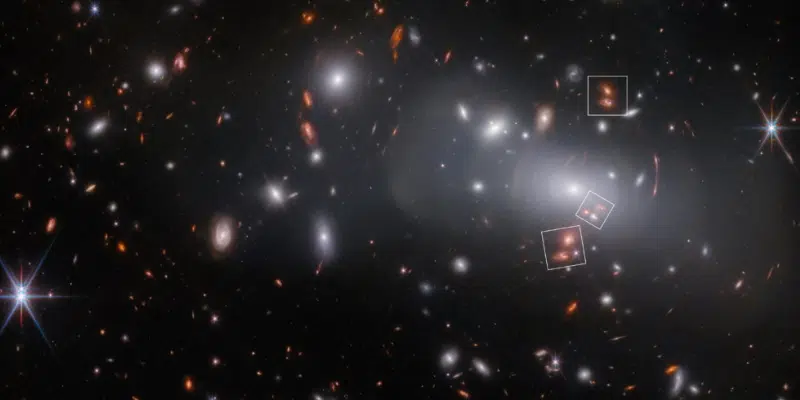
This Webb image features a special galaxy that appears 3 times. Why? There's a galaxy cluster here whose mass and gravity are so great that time and space around it gets warped. This magnifies, multiplies, and distorts galaxies behind it: https://t.co/ftRTPC4bDr pic.twitter.com/fzTjUGc5UO
— NASA Webb Telescope (@NASAWebb) February 28, 2023