


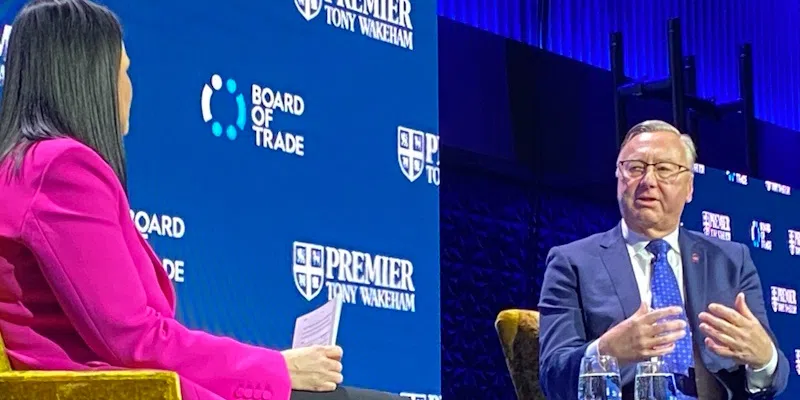
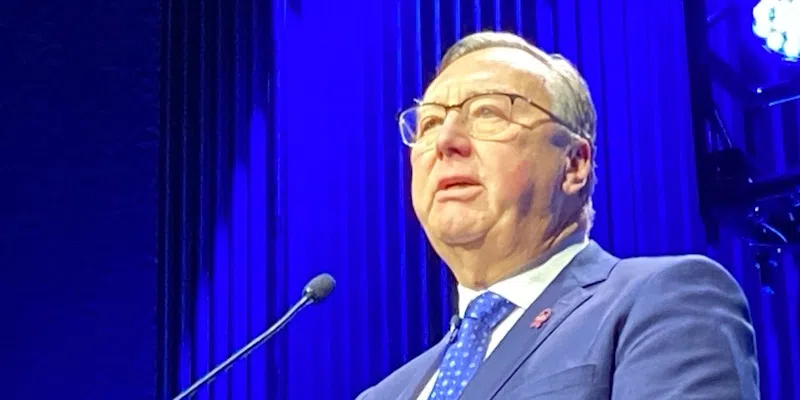
Six weeks after taking office, Premier Tony Wakeham delivered his first state of the province address yesterday, admitting the learning curve has been a sharp one.
“I keep telling people we caught the car, now we’re learning to drive it,” he told the Board of Trade.
Wakeham’s been a man of few, carefully chosen words since elected. But he opened up yesterday like a floodgate on the Churchill, “making sure” he checked all the boxes critical to the immediate future of the province.
On the MOU, the promised independent review will begin before the new year, it won’t be bound by an “artificial” April deadline, and the referendum is still a go, even thought the precise question remains unclear.
(VOCM News)
Also before the new year an update on the financial state of the province, with Wakeham suggesting the Liberals low-balled the $600-million deficit quoted in August. And the House will not reopen this session, blamed largely on the Liberals’ right to request recounts.
The premier takes two other big files into meetings today with Prime Minister Mark Carney in Ottawa; a fair share of defence spending and, of course, Bay du Nord.
Equinor, he said, is now open to doing all topsides and modules here if it doesn’t affect cost or schedule, calling it a major shift and boon for local labour.
As for AI, Wakeham is all for a review of its use in government after it was blamed for fake citations in another report – this one by consultants Deloitte.
The premier was asked if he’d hire them to review the Churchill Falls MOU, but his response was brief.
“Ha, ha, ha. No.”
Deloitte Admits to Use of AI in Report

From Deloitte’s Human Health Resources Plan
Meanwhile, Deloitte, the company that authored the province’s Human Health Resources Plan, confirms that AI was “selectively used” to “support a small number of research citations” in the report, but that the technology was not used to write it.
The Independent first reported over the weekend that at least four sources cited in the report did not exist, something which was later confirmed by the provincial government.
Deloitte says it “firmly” stands by the recommendations made in the report, noting that it is revisiting the document to make a “small number of citation corrections, “which do not affect the report’s findings.”
They state that they are “fully responsible for the quality of (their) work,” and are committed to continually evolving their practices around the use of AI and other emerging technologies.