


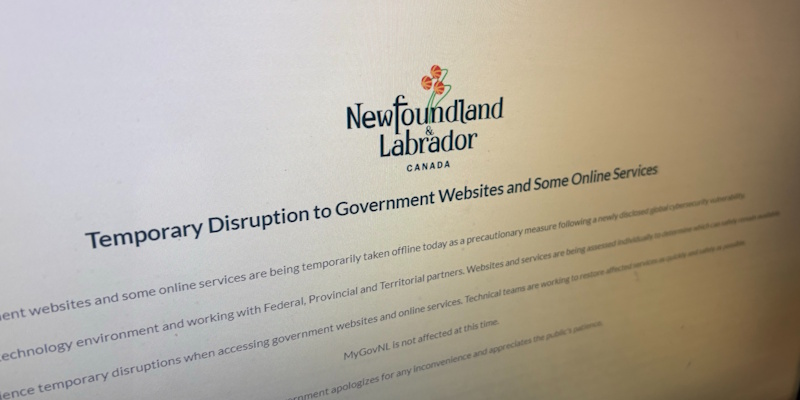
The provincial government is taking its websites and some online services offline as a precautionary measure due to what is being described as a “newly disclosed global cybersecurity vulnerability.”
It says technical teams are assessing the situation and working to restore affected services. It’s working with federal, provincial, and territorial partners on the situation.
Government release issued today
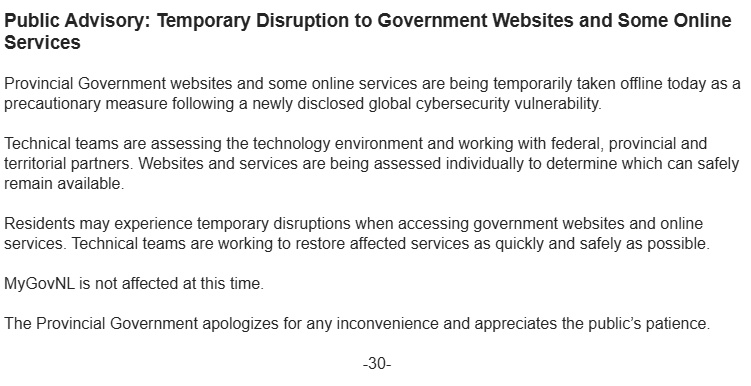
Government’s release issued today (Government of NL)
All websites and services are being assessed on an individual basis to determine which ones can remain available.
MyGovNL is not affected at this time.
Memorial University is also facing a similar disruption, which includes it’s MyMUN service and MUN.ca.
VOCM News is following the situation and will provide more information as it becomes available.
Canadian Centre for Cyber Security Issues Warning
The Canadian Centre for Cyber Security today issued an alert on a “recently identified cyber threat.”
The Cyber Centre says it is aware of “critical vulnerabilities” affecting multiple versions of PHP – a technology used to support a “substantial proportion of web applications worldwide.”
The centre says critical flaws in PHP could let an attacker take control of a web server without having to log in, so the centre is “strongly” recommending that organizations running affected PHP versions upgrade their systems.
Government agencies across the province and country have taken their websites offline as a precaution.
A number of countries including the Netherlands, Finland, and France have done the same.
The Cyber Centre recommends that organizations:
- Update affected PHP installations immediately to a fixed, supported release.
- Prioritize Internet-facing systems and applications that process untrusted input.
- Identify third-party products, appliances and containers that include vulnerable PHP componentsFootnote7.
- Where immediate remediation is not feasible, organisations should consider isolating internet-facing applications from public networks until a fix can be applied.
- Monitor for potential compromise by reviewing web server, application, authentication, and endpoint logs for suspicious activity.
- Investigate unexpected processes, commands, files, accounts or outbound connections associated with PHP or web-server services.
- Continuously monitor third-party vendors for security updates, including appliances, applications and services that bundle PHP, and apply applicable patches without delay.