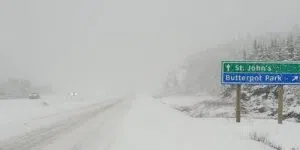



The heavy snowfall, closing in on 70 centimetres, is taking its toll on the Battery.
There was an avalanche early Friday evening that sent snow crashing into a home in the Outer Battery. There were no major injuries reported.
Tonight, the City of St. John’s is working to evacuate families from the affected area of the Battery. It’s a combined effort involving the St. John’s Regional Fire Department, snowclearing crews and the RNC.
There is concern for the safety of people in the Battery as snow continues to fall. Conditions are extremely difficult as the winds continue to howl.
Reports confirmed! Firefighters at my door in outer battery asking to evacuate us. pic.twitter.com/YuAWJQxG8w
— Will Durocher (@WillDurocher) January 17, 2020
Snowclearing crews are trying to clear the path.
People on Facebook have been offering up accommodations to those being displaced.
Snow fences were installed in the area some years ago to help protect the homes below.
Snowfall—approaching 50 cm—had fallen in the area as of 5 p.m., and wind gusts in excess of 100 km/h, creating extreme conditions for first responders.
An avalanche in the area in February 1959 claimed five lives.
Current situation at the bottom of Signal Hill and Battery Road. Been here in the intersection for an hour or so now. #nlwx #nltraffic #snowmaggedon2020 @VOCMNEWS @CBCNL pic.twitter.com/b6cpNrBjEc
— Jillian “There might be cat fur on that” Parsons (@jc_parsons) January 17, 2020
An avalanche in the Battery in February of 1959 claimed the lives of five people.
Peak winds in the capital city reached 119 km/h through 5:30 p.m., according to Environment Canada meteorologist Rodney Barney.
Update: some peak winds (km/h) thru 5:30 pm:
167 (Green I, Fortune Bay);
157 (Bonavista);
156 (Heart's Delight);
150 (Cape Bonavista);
146 (Cape Pine);
146 (Grates Cove);
127 (Green I, Trinity Bay);
126 (Pass Island);
119 (St John's – E White Hills);
116 (Allan's Island).#nlwx— Rodney Barney (@rcbstormpost) January 17, 2020