


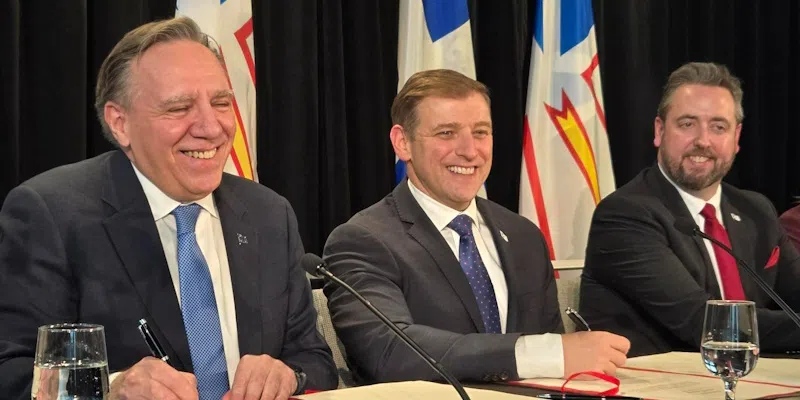
Newfoundland and Labrador has signed what’s being described an historic agreement with the province of Quebec to “terminate and replace” the 1969 Upper Churchill contract, and develop several other projects, including Gull Island.
“Today, everything changes for Newfoundland and Labrador,” Premier Andrew Furey stated during the announcement at The Rooms in St. John’s this afternoon.
It was also announced that there will be a special sitting of the House of Assembly in January to debate the agreement.
It’s expected the total value of the deal for this province, over the life of all agreements, will be $225 billion.
The new agreement, announced as a memorandum of understanding, will be retroactive to Jan. 1, 2025 once the deal is finalized.
A major component will be a change in the price per kilowatt hour from 0.2 cents to 5.9 cents – thirty times the current deal — charged by the province.
Between now and 2041, when the old contract was to expire, that increase will equal $1 billion per year in revenue to the province, compared to the $20 million received now.
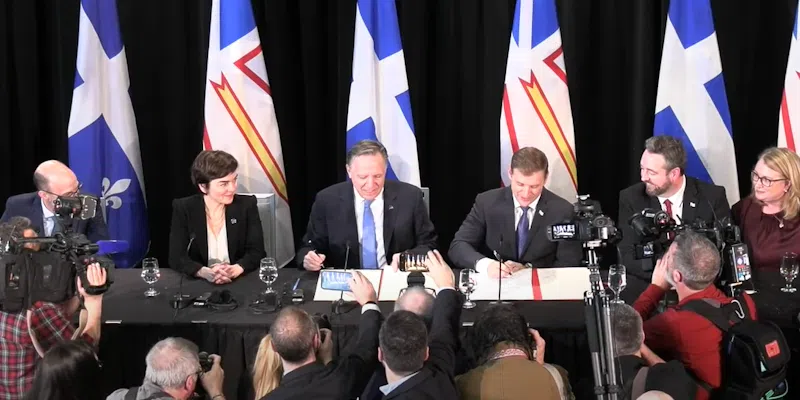
(Signing the M.O.U.)
The agreement also includes a price escalator, absent in the 1969 contract, which will be based on market value over the life of the contract.
Three new developments are also included in the agreement, all of which are expected to increase capacity in Labrador by 3,900 megawatts.
Quebec, meanwhile, will pay $3.5 billion for the rights to co-develop the projects.
A Gull Island generating station will be built and equipped with a capacity of 2,250 MW, while a new powerhouse will be added at Churchill Falls providing another 1,100 MW.
Quebec will bear the full responsibility for construction risks and cost overruns on those projects. The capacity at Churchill Falls will also be increased by 550 MW, with this province leading that project.
Costs for new transmission lines will be the responsibility of NL Hydro and Hydro-Quebec in their respective jurisdictions.
The target date for completion of all agreements under the M.O.U., of which there are many, is April 30th, 2026.

Premier Furey and Chief Pokue. (VOCM News)
The deal is of particular interest to Indigenous groups in Labrador, especially the Innu Nation, which had previously said they would block the development of Gull island if outstanding issues related to Churchill Falls were not addressed.
The agreement is purported to fully respect existing agreements with Indigenous groups, and both provinces have agreed to engage with them “at every step” of the development of each project.
Innu Nation Grand Chief Simon Pokue called this “a historic day” for both provinces and the Innu. He says the M.O.U. “respects our deep relationship” with the (Churchill River waterway) and the land that is central to our people.”
It also respects the New Dawn agreement with the province, he said, and “provides inclusion for the Innu of Labrador in future energy projects.”
Furey is travelling to the Big Land on Friday to share details of the new agreement.
He’s hosting an event at the Lawrence O’Brien Arts Centre in Goose Bay at 10 a.m. local time with MHAs Lisa Dempster and Perry Trimper, and NL Hydro CEO Jennifer Williams, before heading to Churchill Falls to do the same.
No rate increases
Meanwhile, there will be no rate increases for people in Labrador as a result of the deal.
Nor will there be rate changes arising from the agreement for residential and general service customers, and there will be no immediate impact on industrial rates.
Government says it will assess the industrial rates policy in the coming years.
However, cost of the new developments will be based on actual construction and operating costs, and are expected to escalate over time.