



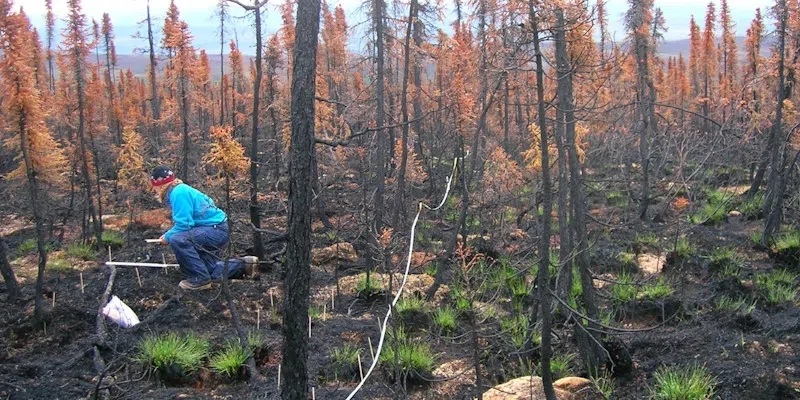
A research team from Memorial University’s geography department is hoping to fan out across the province this summer to study plant and forest regeneration in areas affected by last year’s wildfires.
Research lead, professor Carissa Brown of the Northern Edge Lab, says fire has been part of Canada’s boreal forests for thousands of years, and many species have adapted in amazing ways to regenerating after a fire.

Fireweed in a burned-over area in the Yukon (submitted by Carissa Brown)
Fireweed for instance, is usually one of the first species to start sprouting up after a fire.
She describes the plentiful black spruce as “one of the coolest fire adapted trees around.”
Brown says black spruce are recognizable because of a dense collection of cones at the top of the tree.
“They actually save their cones up on the top of the tree for multiple years. So you might have three or four or five years worth of cones just sitting and waiting on top of that tree full of seeds, and that’s an adaptation so that if a fire does come through, they have a whole bunch of seeds ready to be dispersed right afterward.”

Black spruce seedling following a forest fire (Submitted by Carissa Brown)
She says cones, which are normally closed tight, will open in the heat of a fire to help disperse seeds.
Meanwhile other species, like blueberry bushes, grasses and some trees have deep root systems that allow them to regenerate even if the top portion of the plant has burned away.
Brown says forests can bounce back surprisingly quickly, but they may end up looking very different. That will be part of the research they’re planning this summer.
“There were areas burned that were balsam fir forests before the fire. And balsam fir is not a species that is adapted to regenerating after fire. So I’m going to roughly guess that those areas that were pretty continuous balsam fir forest, they’re going to look different over the next few years. So we’re going to have some other tree species potentially come in.”