


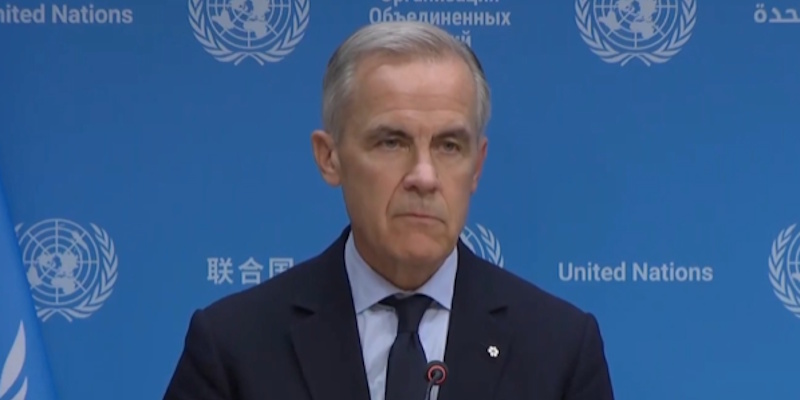
Prime Minister Mark Carney spoke at the United Nations yesterday and, in stark contrast to U.S. President Donald Trump’s critical assessment of the U.N. and its purpose, Carney argues a multi-lateral approach to global challenges is necessary.
The United Nations was formed after the Second World War to bring countries together to find solutions to common problems facing humanity.
Carney says if a multi-lateral system fails to reflect the realities of the time, it won’t stand the test of that time; however, the need for multi-lateral co-operation is “very much alive.”
“Climate emergency is intensifying, AI advancing faster than our capacity to control it, pandemics spreading across continents in weeks, (and) financial shocks can disrupt markets and economies…and no one country, no matter how powerful, can manage these challenges alone.”
Carney says co-operation is not an act of idealism, it is a “practical necessity.”

Lori Turnbull in studio (VOCM News)
Political scientist says Carney facing challenges at home
Dalhousie University political scientist Lori Turnbull says the Prime Minister has a lot of experience internationally having served as the governor of the Bank of England for years.
Despite his profile on the world stage, Turnbull says Carney’s attendance in the House of Commons is low, and he has some challenges ahead here at home.
She says there’s “all kinds of stuff” that are in the Building Canada Strong Act introduced this week “that is going to hit the wall.” While Turnbull expects it will be passed in the House of Commons, she highlights provisions like the minister being able to take stronger action when it comes to strikes in the federal service. “We have a Constitutional right to collective bargaining in Canada; that’s something that’s going to have to be worked out….in the bill and questions will come at the government on this one.”