



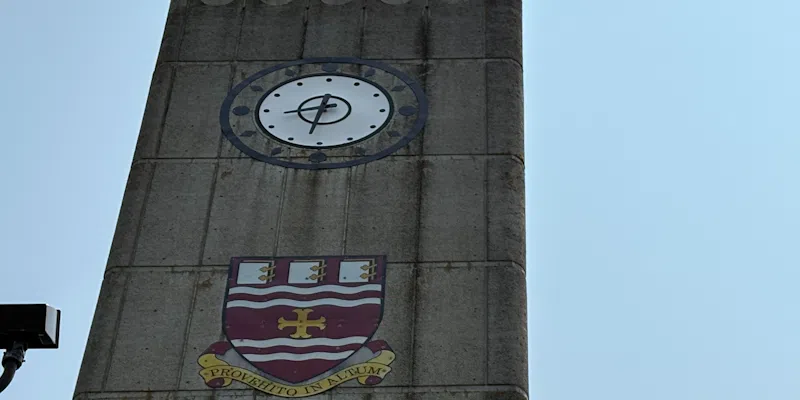
Memorial University has received $31-million from the Hebron and Hibernia projects to help improve student learning, research capacity and innovation focused primarily on the Faculty of Engineering and Applied Science.
MUN calls it a “milestone” and “transformative” investment.
Vice-president (research) at Memorial, Dr. Tana Allen, says the money will be used to prepare and train the next generation of leaders and find solutions to “pressing issues.”
Projects that will benefit from the funding include its Student Design Hub, Memorial’s Centre for Artificial Intelligence Placement Program, and the Canadian Network for Innovative Shipbuilding, Marine Research and Training.
More information on the projects can be found below:
Student Design Hub
Phase three of the pan-university Student Design Hub, located in the Faculty of Engineering and Applied Science, will expand supports and multidisciplinary collaboration for student design teams, enabling them to compete on national and international stages and foster the innovation and entrepreneurial spirit of future start-up founders.
The Hebron and Hibernia projects each contributed $990,000, totalling $1.98 million, and will benefit 500 students.
Memorial Centre for Artificial Intelligence Placement Program Support
Led by Dr. Stephen Czarnuch, associate professor, Department of Electrical and Computer Engineering, and jointly appointed with the Faculty of Medicine, the project will provide high-impact placements and strengthen supports for more than 150 students.
Funded by the Hebron Project at $860,000, the initiative allows students to train directly within the province’s growing technology industry.
Funded projects establishing world-class laboratories include the following:
SMART Materials Additive-manufacturing Research Technologies (SMART)
At $16 million, the Hebron Project’s largest single investment is to establish a state-of-the-art additive manufacturing lab, to be led by Dr. Ahmed Elruby, assistant professor, Department of Mechanical and Mechatronics Engineering.
The funding will be used to purchase new equipment for the lab, providing a foundation to develop new capabilities in design, manufacturing, testing and certification techniques.
The lab will accelerate discoveries in high-performance metal and composite components, corrosion-resistant materials and quality-control techniques through the training of 29 highly qualified personnel.
Special Core Analysis for Supercritical CO2
Led by Dr. Lesley James, professor, Department of Process Engineering, the Special Core Analysis for Supercritical CO2 project will receive $3.4 million each from the Hebron and Hibernia projects, totalling $6.8 million to upgrade specialized laboratory capabilities to support Newfoundland and Labrador’s carbon capture and storage research.
By training future experts and developing innovative methods, it positions Newfoundland and Labrador as a leader in sustainable energy solutions.
Fourteen students will be trained as highly qualified personnel.
Funded projects supporting breakthroughs in research and innovation include the following:
Canadian Network for Innovative Shipbuilding Marine Research and Training (CISMaRT)
CISMaRT, led by Dr. Wei Qiu, professor and head, Department of Ocean and Naval Architectural Engineering, will receive a total of $2.9 million — $1.45 million each from the Hebron and Hibernia projects — to support Canada’s marine industry.
The funding will help expand and deepen collaborations among academia, government and industry to advance autonomous, remote and AI-enabled marine technologies, while supporting the training of 30 highly qualified personnel.
Extractive Industries 2.0
A multi-year research project will help innovate extractive industries, such as oil and gas and mining, in Newfoundland and Labrador.
The project is led by Dr. Ray Gosine, professor, and Dr. Thumeera Wanasinghe, assistant professor, both in the Department of Electrical and Computer Engineering, along with Dr. Gary Thompson, dean, School of Sustainable Development, College of the North Atlantic, and the project’s research director, Dr. Scott McKnight.
A $2.5-million investment from the Hebron Project will help leverage expertise from the province’s energy sector to inform transformations in the mining industry through technologies such as AI, data analytics and digital twins.
Twenty highly qualified personnel will be trained during the project, with collaborators from the Faculty of Business Administration; and the Department of Geography, Faculty of Humanities and Social Sciences; as well as collaborators from the Munk School of Global Affairs and Public Policy, University of Toronto and the University of Sydney Business School.