


It was 25 years ago today the world watched in horror as terrorist attacks were carried out in the United States. Thousands of innocent people were killed, millions were shattered and the world that once was changed in an instant.

TOPSHOT – US President George W. Bush has his early morning school reading event interupted by his Chief of Staff Andrew Card (L) shortly after news of the New York City airplane crashes was available in Sarasota, Florida. AFP Photo Paul J. RICHARDS (Photo by Paul J. RICHARDS / AFP) (Photo by PAUL J. RICHARDS-/AFP via Getty Images)
On the morning of September 11, 19 hijackers boarded four flights with the first plane, American Airlines Flight 11, hitting the North Tower at 8:46 a.m.
Then-President George W. Bush was visiting an elementary school in Florida that morning when his Chief of Staff interrupted to whisper the news in his ear – a moment that has become immortalized in history.
At the time, Bush was under the impression that it was a tragic accident. It was confirmed to be a deliberate attack at 9:03 a.m. when a second plane, United Airlines Flight 175, hit the South Tower.
LISTEN: VOCM News anchor Vince Gallant interrupts Open Line with Breaking News
Listen to “VOCM News – Breaking News – Sept 11, 2001” on Spreaker.
Regular programming on major networks, many of which are based in New York, was interrupted as news broke of the attacks and eventual collapse of the Twin Towers.
Seasoned journalists and talk show hosts were noticeably shaken as the events were broadcast live to millions of viewers around the world who were now glued to a television screen.
As chaos was unfolding in New York City, terrorists had gained control of American Airlines Flight 77, crashing into the Pentagon at 9:37 a.m.

184 people inside the Pentagon were killed that day (U.S. Department of Justice)
At 10:03, a fourth plane, United Airlines Flight 93, was taken over by al-Qaeda terrorists and headed for Washington. Passengers and crew fought back, forcing the hijacker to crash the plane into a field in Pennsylvania.

Remains of Flight 93 in Pennsylvania (U.S. Department of Justice)
There were no survivors on board any of the aircraft involved, on top of thousands of casualties on the ground at the World Trade Center and the Pentagon. 2,977 people died that day alone – and thousands more, particularly first responders, succumbed to illnesses linked to 9/11 in the years that followed.
As the United States was deemed under attack, the call was made to shut down U.S. airspace immediately – meaning transatlantic flights were ordered to land at the nearest airport.

A map showing the hijacked planes on September 11, 2001 (VOCM News)
Major airlines from all over the world began touching down in Gander, St. John’s, Stephenville, and Goose Bay – with thousands of passengers stranded, and, at first unaware of the terror unfolding in the United States.
Passengers spent hours on the tarmac before disembarking – many rushing to a payphone to call their loved ones, and many hearing and seeing the horrific attacks for the first time.
LISTEN: VOCM’s Newfoundland and Labrador Today with Linda Swain – September 11, 2001
Listen to “VOCM’s NL Today – Sept 11, 2001” on Spreaker.
The Day the World Came to Town
Gander – 38 planes – 6,656 passengers
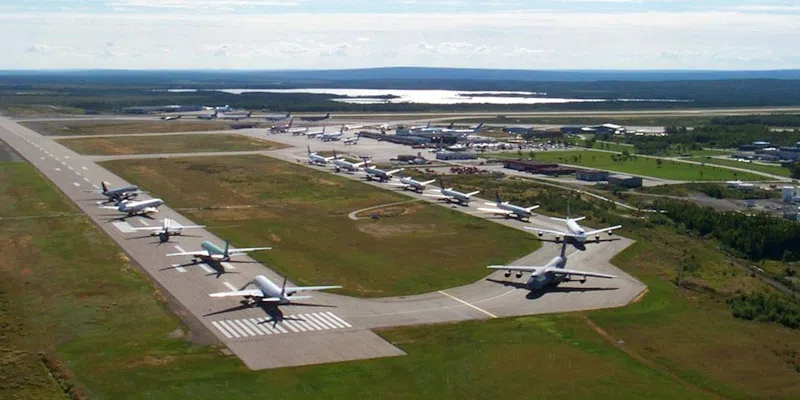
Gander International Airport on September 11th, 2001 (Town of Gander)
With 38 planes touching down at YQX, the town of Gander’s population had nearly doubled by lunchtime.
It didn’t take long for residents to spring into action – the only issue was finding the space to put everybody. Despite opening the school, the local community centre, and other public spaces, there simply wasn’t enough room.
That’s when residents in Gander and surrounding communities swung their doors open to house families in need of shelter.

Residents of Gander and surrounding areas punched countless hours helping out thousands of stranded passengers (Town of Gander)
Striking bus drivers returned to work to help shuttle the so-called ‘plane people’ to their accommodations. Volunteers worked countless hours making sure the newcomers were not only well fed, but also well entertained.
The thousands of strangers who stepped off the tarmac that day left four days later as friends.
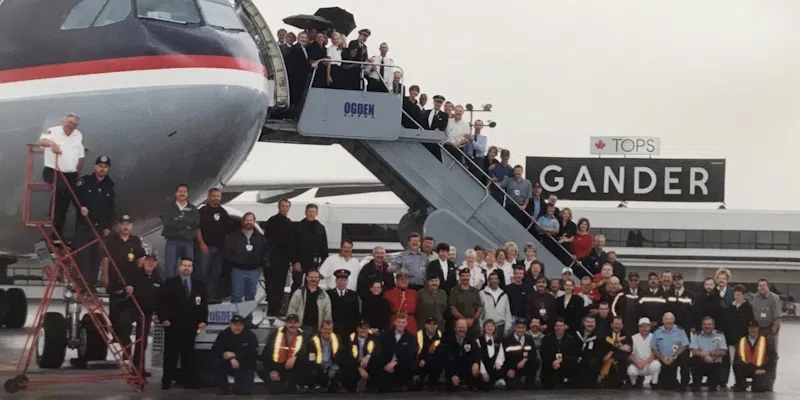
An international flight crew forced to divert to Gander International (Town of Gander)
The stories of Gander have become the stuff of legend, due in large part to the success of the Broadway musical Come from Away – a show which has been put on in theatres around the world since its debut in 2017.

Rick Mercer stars in the Canadian Heritage Minute highlighting Gander’s efforts during 9/11 (Historica Canada)
A Canadian Heritage Minute has since been released depicting the response to 9/11 with Rick Mercer portraying then-Gander Mayor Claude Elliott.
St. John’s – 21 planes – roughly 5,000 passengers

Planes from all over the world parked at YYT on September 11, 2001 (St. John’s International Airport)
Although the hub of activity for air travel in Newfoundland and Labrador, St. John’s International was only used to seeing a handful of widebody aircraft in the run of a day – on September 11, there were 21 parked on the tarmac.
Places like Memorial University, the Convention Centre and Mile One soon became temporary shelters as there were too many people to put up in hotels across the capital city.
Much like other areas, volunteers assisted in caring for the passengers through meals and accommodations, but there was another problem – travellers were forced to leave their bags on the aircraft, which meant most only had the clothes on their backs.

(St. John’s International Airport)
It also meant that most people were without their medications. With the Health Sciences and St. Clare’s only able to handle so much, a medical team was struck and a temporary clinic was established in the coat-check room at the Convention Centre.
It’s believed that nearly every passenger interacted with the health team at least once during their stay. Some people required a trip to the emergency room while two people were admitted.
Most medical visits were to refill medications – which were picked up and dropped off by volunteer drivers.

Roughly 5,000 passengers landed at YYT on September 11th, 2001 (St. John’s International Airport)
The last plane departed YYT on September 17.
A ceremony will be taking place at St. John’s International Airport at 11:00 a.m.
Stephenville – 13 planes – 1,096 people

A plaque commemorating Stephenville’s efforts in helping those forced to land during the 9/11 attacks (VOCM News)
One of the community leaders who took charge in the Stephenville region during Newfoundland’s response to the 9/11 terrorist attacks is remembering the effort that took place.
Wayne Ruth is a former vice chair of the Stephenville Airport, and he was the longtime mayor of Kippens.
He recalls widebody aircraft on the airport’s tarmac, and an influx of calls from people looking for their loved ones.
Ruth remembers people calling the airport crying, with nobody getting any sleep that night. Local businesses stayed open to make sure officials had the supplies they needed.
Staff at the College of the North Atlantic threw the books aside, coming to the aid of passengers by providing meals and accommodations.
Some were bused to hotels in nearby Corner Brook, as well as to the former Silver Birches camp near Pasadena, which was run by the Salvation Army.
Every year, a special service is held at St. Stephen’s Parish in memory of those lost on 9/11. This evening’s event begins at 7:00.
Goose Bay – 7 planes – roughly 1,000 passengers
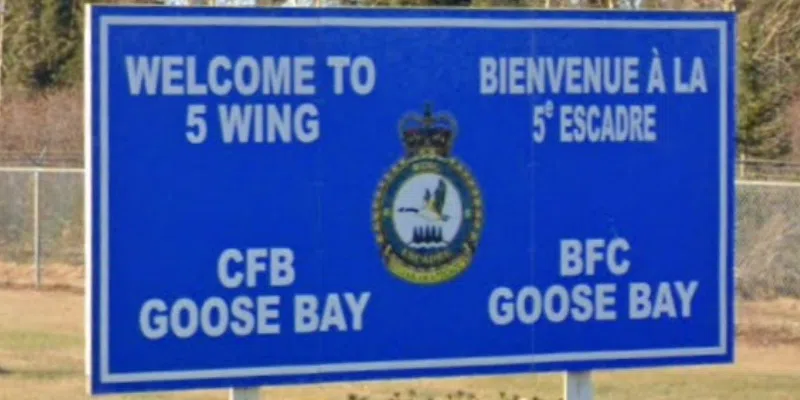
Some aircraft were instructed to land at 5 Wing Goose Bay. Larry Pittman, the former communications manager at 5-Wing, recalled that day in a 2019 interview.
During his time in the role, he was the spokesman for several events and incidents at the military base, but September 11 was unlike anything else.
Pittman was carrying out his regular duties that morning when he got a knock on the door from his admin assistant informing him of what was happening in the United States.
Like others, he figured it was an accident and returned to his work. About five minutes later, another knock at the door – this time, he told her to phone the Command Centre to tell them he was on his way.
As the one responsible for civil aviation in Goose Bay, Pittman says he was heavily reliant on 5 Wing and first responders that day.
At first, he was told to prepare for the arrival of up to 80 aircraft. Seven planes and nearly 1,000 people ended up arriving.
When the call was made for volunteers, Pittman says the residents of Happy Valley-Goose Bay and surrounding area offered themselves up to help out any way possible.
At the time, there was no cell coverage in Goose Bay, and with hundreds of people desperate to get in contact with loved ones, a phone bank was set up for people to call home – something that the airport had done in the past for other diverted aircraft.
To this day, 5-Wing Goose Bay continues to assist diverted aircraft.
What has changed?

Security at St. John’s International Airport (VOCM News)
Before 9/11, restrictions on what was allowed on board an aircraft were much more lenient than they are today. For example, knives of a certain length were permitted and oftentimes, you didn’t even need an ID or boarding pass to get to the terminal.
Gone are the days of showing up to the airport moments before the gates close. Travellers are now accustomed to security checkpoints and restrictions on certain items that have the potential to be hazardous.
For those who remember those days, it may seem like the changes came into effect instantly, and that was more or less the case.
On average, it takes two years to implement any changes to safety regulations – given the urgency after the attacks, ten new security measures were implemented by Transport Canada in just two weeks.
The attacks eventually led to the creation of the Canadian Air Transport Security Authority (CATSA) in 2002, which is responsible for screening tens of thousands of passengers at airports across Canada every day.
Never Forget

The 9/11 Memorial in New York City (VOCM News)
The phrase ‘never forget’ is commonly associated with September 11, 2001 – that is why communities like Gander come together every year to commemorate the tragedies that unfolded.
Several ceremonies are taking place today, including one in New York City.

The 9/11 Memorial in New York City (VOCM News)
Gander, which has held an event every year since 2001, will be holding its ceremony at the Steele Community Centre this afternoon at 2:00.
Those in attendance include former Prime Minister Jean Chrétien, Governor General Louise Arbour, U.S. Ambassador Pete Hoekstra as well as Premier Tony Wakeham.
The event is free to attend; however, a ticket must be reserved in advance.