


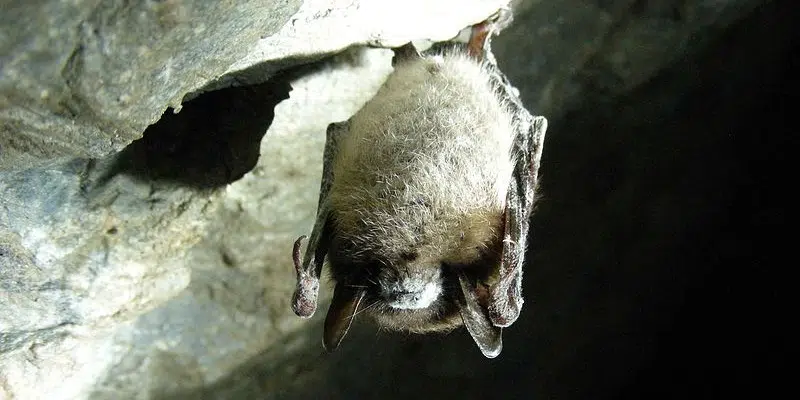
Bat experts, studying the impact of White Nose Syndrome on local bat populations, are hoping that survivors of the devastating fungus can help provide vital information and hope for the survival of local species.
The fungus was first identified in New York state in 2009, likely accidentally introduced to North America by visiting cave explorers.
The fungus, which has devastated bat populations throughout North America, was confirmed on the province’s west coast in 2017.
Jordi Segers, National Bat Health Program Coordinator with the National Office of the Canadian Wildlife Health Cooperative in PEI, says while the fungus has nearly wiped out entire colonies, some bats do survive. It’s those animals researchers are most interested in hoping to learn what factors are helping the tiny mammals survive.
He says they’re trying to figure out if some of these bats have a genetic advantage that’s creating immunity to the fungus. It’s hoped that evolution will take over, and survivors will give birth to pups that carry the same immunity.
The fungus responsible for White Nose Syndrome occurs naturally in Europe but does not affect bats on that continent. In the meantime, local researchers are counting on citizen science to help identify bat populations. If you see or discover a bat or bats, do not touch or disturb them, but call the bat hotline at 1-833-434-2287 (BATS).